
Pottawatomie Projected and Actual Release
A projected release date, often shortened to PRD, is an administrative estimate built from the controlling sentence and credits known at that point. An actual release date records what occurred after all required checks and processing. The two dates can match, but they serve different purposes. A future PRD does not prove that a person has left a Pottawatomie County facility or an Oklahoma prison.
Pretrial detainees require a different analysis. They have not begun serving a final prison term merely because they are held at the Pottawatomie County Public Safety Center. Release may turn on bond, dismissal, a personal-recognizance order, a plea, sentencing, or another agency’s hold. Even after a judge signs an order, jail staff must check for holds and complete discharge work. A scheduled court event is therefore not a reliable pickup time.
For a sentenced ODOC prisoner, Sentence Administration uses the judgment, time credited, sentence relationships, earned credits, and later legal events. For a county sentence, use the jail and court sources. Do not apply an ODOC projection to someone who only bonded out of PCPSC, and do not use the current jail roster to calculate a state-prison term.
Find a Pottawatomie Release Date
Classify the custody episode first. The ODOC offender lookup is the principal public route for someone committed to Oklahoma state custody, including a person at Mabel Bassett Correctional Center. It is not a full index of everyone once held in the county jail. A person who left PCPSC on bond or completed a local sentence may never have an ODOC record.
Use an ODOC number when available. With a name search, match the result to the case and known identifiers before relying on it. The public record can include an ODOC number, photograph, descriptors, current location or status, offense and sentence data, reception information, and release-related fields. ODOC cautions that the lookup is abbreviated and does not precisely explain time to serve.
- Determine whether the person is pretrial, serving a Pottawatomie County sentence, or committed to ODOC.
- For ODOC custody, search by ODOC number or a carefully matched legal name and open the full detail.
- Compare location, status, sentence entries, reception data, and any projected, release, or discharge field.
- For PCPSC custody, review the court docket for bond or sentence orders and ask the jail what scheduled information it maintains.
- Check for warrants, detainers, consecutive terms, amended judgments, or other records that may control the next move.
- After release, obtain the actual discharge entry rather than treating the earlier estimate as final.
The full county-jail confirmation sequence is available through the Pottawatomie County release-record search. It pairs the court event with the jail register’s date and manner of discharge.
The official search form shows the state entry point.
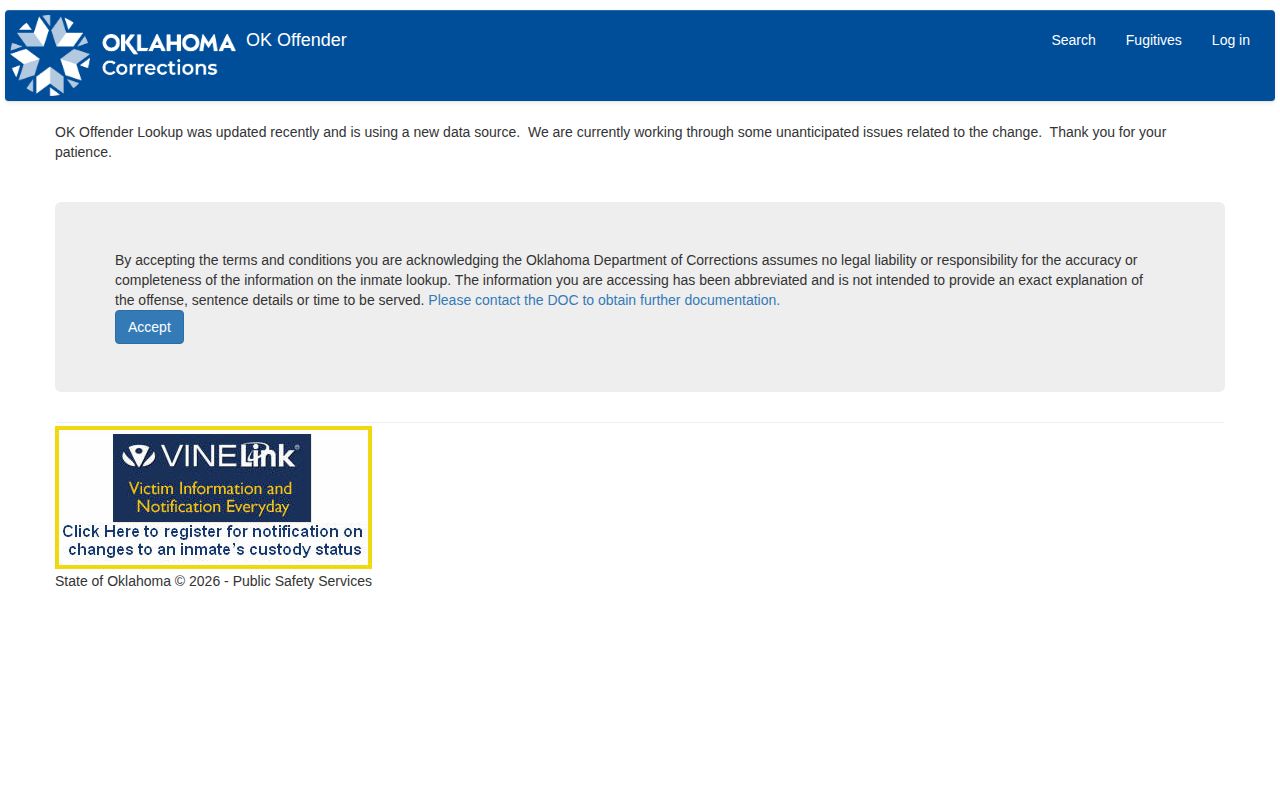
Once a result is matched, read status and sentence information together instead of isolating one date label.
ODOC Pottawatomie Release Date Records
ODOC formally uses Projected Release Date in its Section 06 materials. The policy index lists a PRD attachment under OP-060203, while sentence-administration policy explains how time remaining is updated. The public offender-information guidance also says an individual release date is confidential without a legitimate need and is always tentative. That means an exact future date may not appear for every public lookup.
The official Section 06 forms and policy index documents the agency’s PRD framework.
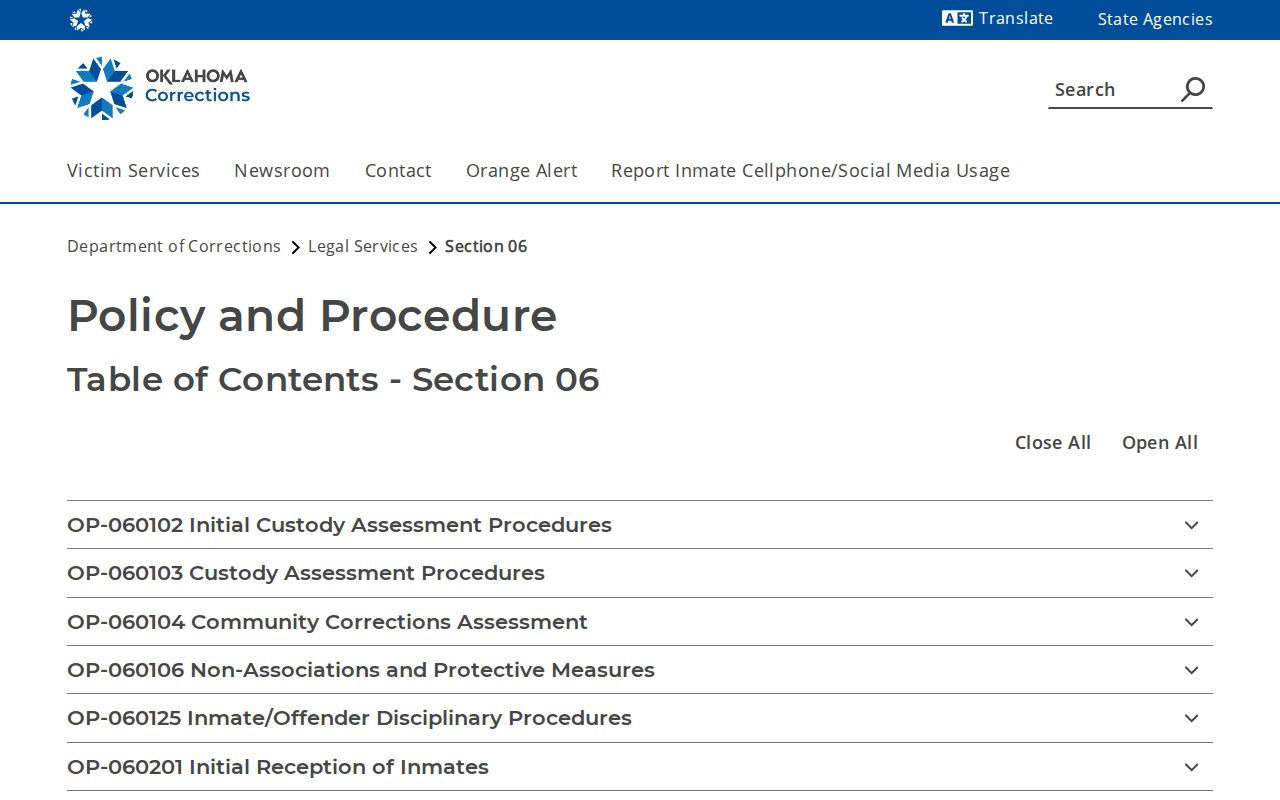
The image identifies the state policy source, not a guaranteed public date for any named person.
Sentence Administration starts with the court’s judgment. Staff account for the imposed term, credited time, and whether multiple sentences run at the same time or one after another. “Concurrent” means terms run together. “Consecutive” means one follows another. Credits and legal events then alter time remaining. The governing ODOC sentence-administration policy is more reliable than a hand calculation.
If the public detail does not resolve the question, request existing records. Ask ODOC for the public offender summary, sentence administration or release computation record as disclosable, actual discharge date and type, and supervision information if applicable. Use the ODOC number in the request. Do not ask agency staff to create a new calculation or publish a private identifier.
Pottawatomie Release Credits and Statutes
Oklahoma earned credits can reduce time remaining for an eligible state prisoner. The main statute is 57 O.S. § 138. In broad terms, monthly credits depend on classification level and the rules that apply to the person and sentence. ODOC policy OP-060107 implements classification and eligibility details. Credits may be earned, denied, lost, or restored, so a copied number can become stale.
The well-known “85 percent” rule is not a universal formula. 21 O.S. § 13.1 lists serious offenses for which at least 85 percent of the imposed sentence must be served before parole consideration, and earned credits cannot reduce service below that threshold. The offense of conviction and the version of law tied to the case matter. It is unsafe to apply the fraction to every Oklahoma conviction.
Parole eligibility also has its own framework in 57 O.S. § 332.7. Eligibility is not the same as release. A person may become eligible for consideration, receive a denial or deferral, or receive favorable action that still requires later approval, conditions, hold checks, and ODOC processing.
Why Pottawatomie Release Dates Change
A PRD changes when an input to the sentence computation changes. Some changes come from conduct and classification. Others come from a court, another custodian, or a correction to the underlying judgment. The date should be read as of the record’s update, with the source and status saved alongside it.
| Change | Possible effect | Best record |
|---|---|---|
| Earned-credit award or restoration | May reduce time remaining when allowed | ODOC sentence computation |
| Credit denial or disciplinary loss | May move the projection later | ODOC credit and sentence records |
| Jail-time credit correction | Can alter the starting balance | Judgment and ODOC computation |
| Amended judgment or appellate relief | Can change the legal term | Filed court order |
| Concurrent or consecutive clarification | Changes how multiple terms run | Judgment and Sentence Administration |
| Detainer or outside hold | May change the next custodian or delay community release | Custodian and receiving-agency records |
| Parole action | May create, defer, deny, or withdraw a supervised release path | Board result plus ODOC status |
Escape or out-to-court time treatment and a statutory recalculation can also affect the official total. A Board result alone does not settle the physical release time. The sentence system must apply the decision and check stipulations or holds. Note: When two dates differ, ask what each timestamp records before deciding that one source is wrong.
Pottawatomie County Jail Release Timing
County sentences require PCPSC and court records unless the person has become an ODOC prisoner. No official Pottawatomie County jail good-time formula or weekend and holiday early-release policy was located in the reviewed sources. State prison credit law should not be used to invent a county practice. Ask PCPSC what scheduled discharge information it maintains for the booking and local sentence.
The overlap can be confusing after a state commitment. A person may be legally committed to ODOC yet remain physically at PCPSC while awaiting a state bed. That person’s court judgment, ODOC status, and county jail record should be checked together. Physical location by itself does not identify the final custodian or the correct computation system.
For a pretrial person, inspect the latest Pottawatomie County docket event. Bond, dismissal, sentencing, a writ, or a transfer order can explain what may happen next. Yet the order and the actual exit time can differ. PCPSC must verify other holds and complete release work. Call 405-273-0043 if authorized pickup depends on whether processing has finished, but do not expect staff to promise an exit based only on a court schedule.
Read Pottawatomie Release Status Correctly
The location and status fields must be read before the date. A named Oklahoma prison normally points to secure state custody. A parole, probation, GPS, or community-corrections label can mean the person has left secure confinement but remains under correctional control. A discharged or released status paired with a historical date is stronger proof that the identified ODOC episode ended. A future date beside an active prison location remains a projection.
Mabel Bassett Correctional Center adds a local source of confusion because it is in Pottawatomie County but is an ODOC state prison and statewide women’s reception center. A move from reception at Mabel Bassett to another prison is a transfer, not release. Use the state offender record and sentence administration materials for that episode. By contrast, a person leaving PCPSC after bond may have no ODOC record at all and must be traced through the jail discharge entry and court docket.
Parole records require one more distinction. A favorable Oklahoma Pardon and Parole Board result is a decision-stage record, not an exit scan. ODOC still must apply the outcome, meet any approval requirement, account for stipulations, check detainers, and complete release processing. A denial means the considered parole route did not produce release. A pass or defer moves review. The current ODOC status and later discharge record show what actually followed.
Note: Match the date to its status and custodian before describing a projected event as a completed Pottawatomie County release.
Confirm Pottawatomie Actual Release Dates
After the projected day arrives, confirm the outcome with the record of the agency that held the person. For PCPSC, ask for the jail-register or booking-release entry and its date and manner of discharge. “Transfer” means a custodial handoff, not a return to the community. If the record names ODOC or another receiving agency, continue with that system.
For a state prisoner, look for the completed ODOC status and historical release or discharge information. A parole or community status means secure confinement ended while supervision continues. A discharged status is stronger evidence that the state episode ended. When the public page is ambiguous, an existing public offender summary or discharge record is the better source.
OK VINE can add a custody-change alert for a matched person. Registration and coverage limits are explained on the Pottawatomie County VINELink check. Treat the alert as corroboration, then compare its reporting agency and time with the jail or ODOC record. This sequence distinguishes a tentative date, a completed release from one custodian, and a full discharge.