
Pottawatomie Parole and Probation Compared
Both terms describe supervision in the community, but they begin in different ways. Parole is release from secure Oklahoma Department of Corrections confinement before the sentence is fully discharged, subject to stated conditions. Probation is usually ordered by a court and may follow a brief jail stay or may be imposed without a prison term. A person on either status may be outside a prison or the Pottawatomie County Public Safety Center while still under legal control.
That distinction controls where to look. The Oklahoma Pardon and Parole Board makes and publishes parole decisions. ODOC maintains the offender record and administers day-to-day community supervision. A district court docket may show a probation order, suspended sentence, revocation, or later modification. None of these records should be replaced by a current jail-roster search because a released person normally drops from that display.
| Point | Parole | Probation |
|---|---|---|
| How it begins | Release from secure ODOC confinement under conditions | Court-ordered community supervision |
| Decision source | Parole process, with ODOC completion of release | Judgment, sentence, or later court order |
| Primary status record | ODOC offender record and parole materials | ODOC status plus the sentencing docket |
| Does jail absence prove it? | No | No |
| How it ends | Formal discharge or other official termination | Court and supervision records show completion or termination |
- Discharge
- The official end of a custody or supervision episode.
- Absconder
- A status alleging that a supervised person stopped complying or reporting; it does not itself prove arrest.
- Revocation
- An official action that can withdraw a community status after a violation process.
- Detainer
- A request or hold from another authority that may delay release or change the next custodian.
Verify Pottawatomie Post-Release Supervision
Start with the custody system that imposed the status. For an ODOC case, the official Oklahoma offender lookup is the main public starting point. Search by ODOC number when possible because names can collide. A result may show a prison, community-corrections setting, parole, probation, GPS-type status, or discharge. Read the full result and compare its identifiers with the court case.
A community location or parole label can show that secure confinement ended while correctional control continues. It does not reveal private reporting details, and those details should not be sought or published. When a record is unclear, the right next step is to ask ODOC for the verification process. The county jail roster is not a substitute. The broader Pottawatomie County released-inmate search path explains how the jail discharge record and court docket confirm the earlier release event.
- Identify the person with an ODOC number or a matched legal name and case record.
- Open the ODOC detail and compare status, location, sentence entries, reception information, and any release or discharge information.
- For parole, locate the correct month in the Board docket and results archive, then read its legend and the exact case row.
- For probation, review the Pottawatomie County court docket for the judgment, suspended or deferred term, and any revocation entry.
- Contact the Shawnee probation-and-parole office to ask for the proper official channel to verify the serving office.
- Request an existing ODOC record if the public result does not resolve whether supervision is active or discharged.
Important: A person can be released from a prison and remain on parole, probation, community corrections, or another active ODOC status.
Pottawatomie Parole Dockets and Results
The Oklahoma Pardon and Parole Board publishes monthly dockets and results by year and month. Its archive separates parole, administrative parole, Stage One commutation, SIR, and pardon matters. Those are different proceedings. To research one person, use the ODOC number and name to find the case in the proper PDF, then open the matching results file after the meeting.
Common result terms include favorable action, grant or recommendation, denial, pass or defer, no action, stricken, and rescinded. Their meaning depends on the file legend and type of proceeding. A denial means no parole release from that consideration. A pass or defer moves the matter. A rescission withdraws an earlier action. Favorable action may still be subject to required approval, stipulations, a detainer, and ODOC processing, so the Board result is not the physical exit time.
The official parole dockets and results archive shows how the files are organized.
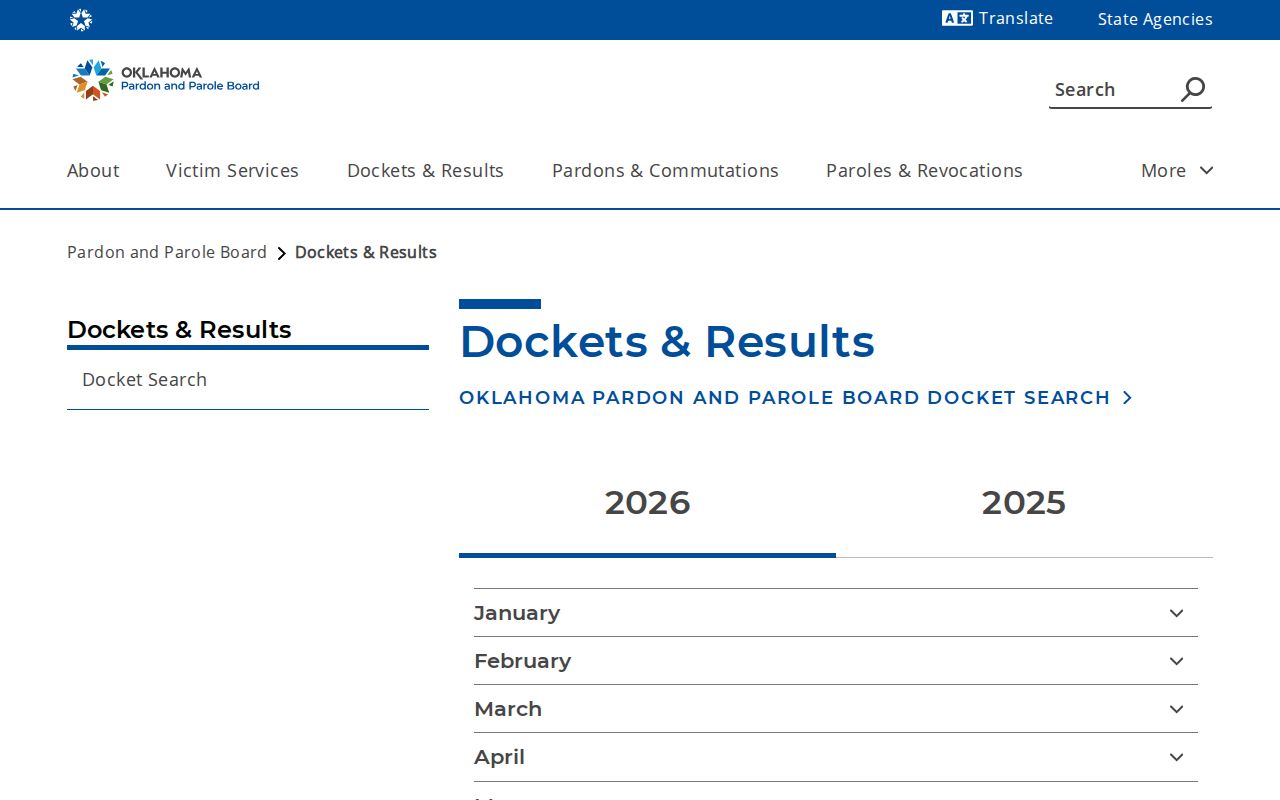
This archive identifies the decision stage, while the ODOC record supplies the later custody or supervision status.
Meeting dates and locations change. Check the Board’s live home page instead of relying on a saved future schedule. Oklahoma law also makes eligibility offense-specific. The parole framework in 57 O.S. § 332.7 and the listed serious-offense rule in 21 O.S. § 13.1 cannot safely be reduced to one fraction for all cases.
Pottawatomie Supervision Office in Shawnee
ODOC’s official probation-and-parole office table lists a Shawnee office that serves Pottawatomie County. This is the local operational contact. It is distinct from the Pardon and Parole Board, which decides and publishes parole matters but does not act as the daily reporting office. The same state page separately lists a regional or sub-office contact for several counties, so that administrative listing should not be assumed to be any one person’s assigned office.
ODOC Shawnee Probation and Parole
800 East Jefferson
Shawnee, OK 74801
405-275-2521
Call to ask which official procedure can confirm the serving office. Do not request or publish a person’s home address, appointment schedule, check-in time, or other private movement detail. The goal is verification of public status, not tracking. If ODOC directs the question elsewhere, follow the agency’s current routing because office assignments can change.
Note: The Board decides parole matters, while ODOC and its Shawnee office administer community supervision for Pottawatomie County.
Pottawatomie Supervision Violations and Warrants
Conditions vary by judgment, release order, and supervision plan. At a high level, they can require reporting, compliance with court orders, approved travel, treatment or programming, and avoidance of new violations. The exact terms must come from the official order or agency record. A general web summary cannot establish what applies to a particular person.
An absconder or warrant label also needs care. Absconder means the supervision authority alleges that the person stopped meeting a reporting or compliance duty. It does not establish that the person has been arrested or returned to custody. A warrant can remain outstanding, be recalled, or be resolved in a later event. Check ODOC’s current status and the court or issuing agency’s warrant record. No current county-specific absconder list was verified on the Pottawatomie County sheriff site.
OK VINE may report a custody change for a matched person, but it is not the supervision file. A VINE event can help confirm that a reporting custodian sent an update. It does not describe every parole or probation condition, and it does not rule out a transfer to another agency.
Pottawatomie Release Reentry Programs
The Pottawatomie County Public Safety Center describes classes and programs intended to help people move back into the community. That is a local institutional effort, but its public history page does not give a release-day enrollment path, eligibility test, schedule, or intake contact. Program-specific questions should go to PCPSC at 405-273-0043 rather than relying on an assumed service plan.
County-jail programming and ODOC supervision are separate. A person released from PCPSC on bond may have court conditions but no ODOC parole status. Someone released from an Oklahoma prison on parole remains in the state supervision system. A probation sentence may begin through the district court. Confirm the legal status first, then ask the correct agency about services linked to that status.
Correct Pottawatomie Supervision Records
Correction requests belong with the office that owns the disputed field. PCPSC directs written complaints about its web information to the Public Safety Center, care of the Web Site Manager, at 14209 Highway 177, Shawnee, Oklahoma 74804. That route concerns jail-site data. A court docket entry belongs with the Court Clerk or court, while a sentence calculation or ODOC status issue belongs with ODOC Sentence Administration.
This record-by-record routing matters after release. One person may have a jail discharge time, a Board decision date, an ODOC status update, and a VINE event time. Those timestamps can differ without one being false because they record distinct acts. Keep the source, event label, and access date with any saved copy. Ask the field owner to review an error rather than sending the same complaint to agencies that cannot alter the record.
Note: A saved screen proves what was displayed then, but the current source record controls after a correction or later event.
Pottawatomie Supervision Discharge Records
Supervision ends through an official act, not from silence in a search result. A discharge entry is the strongest public sign that the identified state episode ended. If the ODOC detail still shows parole, probation, GPS, or a community setting, treat supervision as active until the responsible agency confirms otherwise. If the record says discharged or released, compare the date and status with the sentence and court file.
A local jail release does not itself end probation or parole. Nor does completion of secure confinement always mean completion of the whole sentence. Request the existing public offender summary, actual release or discharge date and type, and any public supervision status when the online record is unclear. Use the ODOC number in a direct request. Personal identifiers needed for agency matching should not be republished.
The final wording should match the proof: “released from secure ODOC confinement on parole” for active parole, “under probation supervision” when that status is verified, or “discharged” only when the official record supports completion. Precise terms prevent a prison exit from being mistaken for the end of all correctional control.